82 Worcester St Unit C, North Grafton, MA 01536
Mon to Wed 8:30 to 5:00 / Thu by appointment / Fri 9:00 to 2:00
Call (508) 839-6464
Implant-Supported Bridge
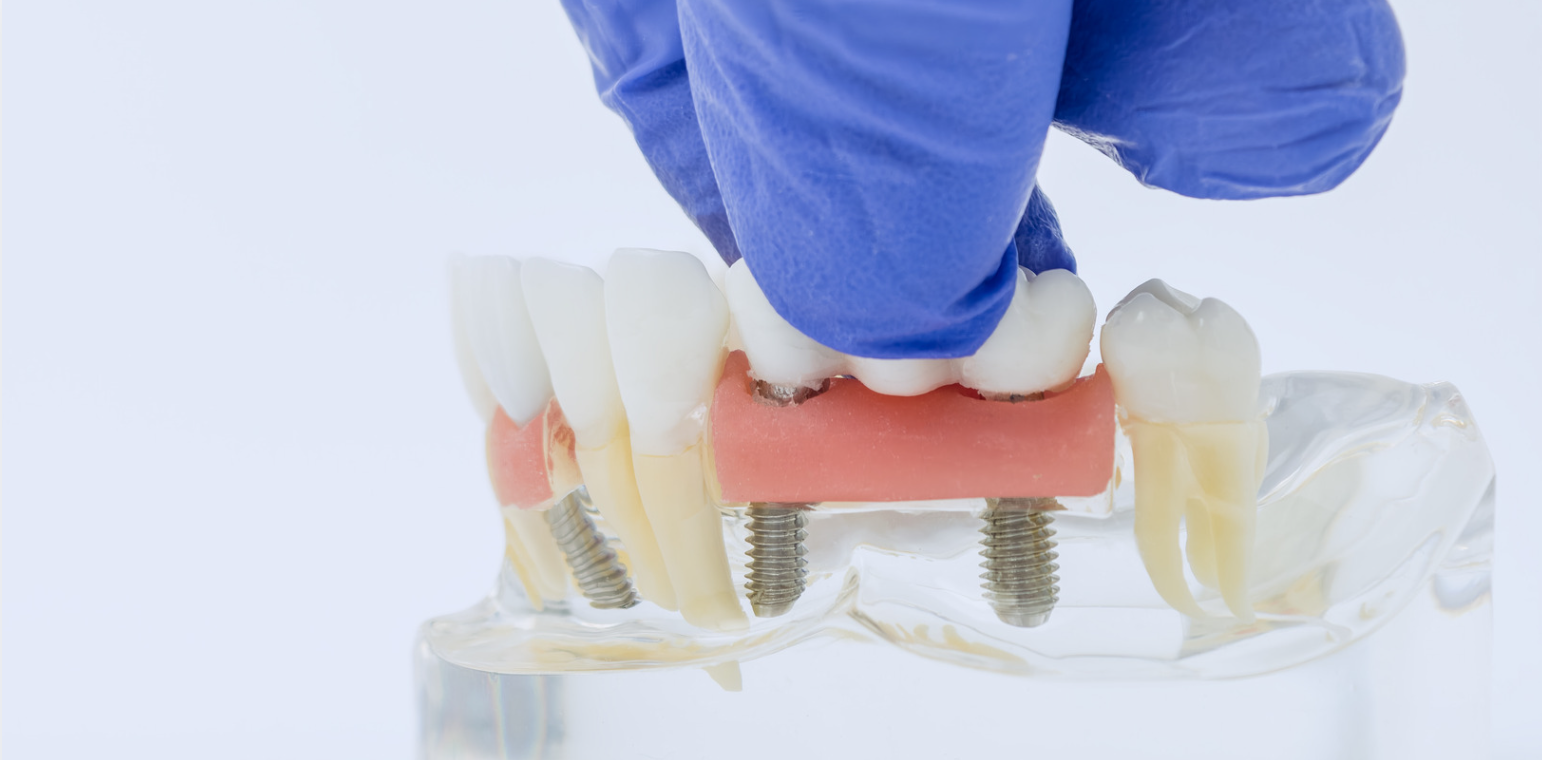
An implant-supported bridge at Grafton Smiles, 82 Worcester St Unit C, North Grafton, MA 01536, replaces several missing teeth in a row on implant piers placed by Dr. Jasjit Sidhu, DDS, FICOI, with no grinding of healthy neighbors. Open Mon to Wed 8:30 to 5:00, Thu by appointment, Fri 9:00 to 2:00. Call (508) 839-6464.
Two posts carrying three teeth is often the most efficient arithmetic in implant dentistry. You get fixed, implant-anchored teeth across the whole gap without placing an implant for every missing tooth, and the plan shows you exactly why the count is what it is.
- Dr. Jasjit Sidhu, DDS, FICOI
The idea
When several teeth in a row are missing, you do not need an implant for every tooth. An implant-supported bridge carries a span of replacement teeth on posts at each end, the way a road bridge carries its deck on piers: two implants can hold three or four teeth, the span is fixed in place, and nothing rests on your gum or hooks onto natural teeth. Two posts, three teeth is the common arithmetic, and it is why this option costs meaningfully less than one implant per missing tooth while chewing nearly as well.
Against the conventional alternative, the comparison is the same one that runs through all implant dentistry: a traditional bridge for a multi-tooth gap either borrows natural teeth as anchors, grinding them down, or is not possible at all when the gap is too long, and either way the bone under the span keeps shrinking. Implant piers load the bone at each end and keep it.
Three ways to fill a three-tooth gap
| Implant-supported bridge | Conventional bridge | Partial denture | |
|---|---|---|---|
| Anchored to | Implant posts in bone | Ground-down natural teeth | Clasps on natural teeth |
| Fixed or removable | Fixed | Fixed | Removable |
| Bone under the gap | Loaded at the piers, preserved there | Continues to shrink | Continues to shrink |
| Healthy neighbors | Untouched | Reshaped for anchor crowns | Carry clasp load |
| Typical fit for | Long-term fixed solution | When neighbors need crowns anyway | Budget or interim solution |
Practicalities
The sequence mirrors single implant treatment with one more moving part: the cone beam scan maps the whole span, the posts are placed where bone is best, healing runs its months, and the bridge is then made as one piece and fixed to the posts. Cleaning is a daily habit worth naming before you commit: the span has undersides, and we teach you the threader, brush or water flosser routine that keeps the gum under it healthy, because that gum health is what the bridge's lifespan runs on.
Repairs, when they come years later, are usually component-level rather than start-over: a chipped tooth on the span can often be repaired or the bridge section remade while the posts stay exactly where they are, which is a structural advantage over tooth-anchored bridges, where a failed anchor tooth takes the whole construction with it.
Candidacy follows the same honest rules as every implant treatment here: the piers need bone, heavy smoking and uncontrolled diabetes work against healing and are discussed before placement rather than after, and gum disease anywhere in the mouth gets treated first, since an implant bridge planted next to untreated gum disease inherits the neighborhood's problems.
Position changes the design conversation. A span in the back of the mouth is engineered for load above all, with materials and pier placement chosen for chewing force; a span in the smile zone adds the esthetic problem of emerging from the gum convincingly, which is where the planning scan and the lab work earn their keep. During healing you are not left with a visible gap: a provisional solution covers the span until the fixed bridge is ready, and which provisional suits you is agreed before the first appointment, not improvised after it.
Cost sits between a single implant and a full arch, is quoted for your case, in writing for the asking before anything is scheduled, and follows the same insurance reality as all implant work: coverage varies by plan, we check yours when you share it, and financing through Cherry is available. If your gap keeps growing because remaining teeth are failing, read the All-on-X page too; sometimes the honest plan is the arch, not the span.
Common questions
The common construction is two implants carrying three or four teeth, with longer spans adding a pier in the middle; the exact count is an engineering decision made on the cone beam scan from your bone volume, bone quality and bite forces. Fewer posts than the span needs shortens its life, and more than it needs adds surgery without benefit, so the number is sized to your jaw. Call Grafton Smiles at (508) 839-6464.
Yes, meaningfully, and that is much of its point: replacing three teeth with two posts and one bridge costs less than three separate implants and crowns while chewing nearly as well. The trade-off is that the span's middle tooth has no root of its own, so the bone directly under it is preserved less than under the piers. We put both numbers and both trade-offs in front of you. Call Grafton Smiles at (508) 839-6464.
Very often yes, and escaping the clasps, the nightly removal and the movement is the usual motivation. The deciding factor is bone at the pier positions, which the scan measures honestly; years under a partial denture shrink the ridge, so some patients graft first. The reward is a span that is fixed in place and loads the bone instead of resting on it. Call Grafton Smiles at (508) 839-6464.
The posts, once fused, commonly last decades; the bridge itself is a wear part that may need replacement or repair over the years, and the whole construction's lifespan runs on the health of the gum around the implants. Daily cleaning under the span and regular professional maintenance are what keep it working, which is why we teach the cleaning routine before you commit, not after. Call Grafton Smiles at (508) 839-6464.
Dr. Jasjit Sidhu plans and places implant-supported bridges at the North Grafton office, on the practice's own cone beam 3D imaging, with the Fellowship of the International Congress of Oral Implantologists behind the planning. Cases genuinely beyond a general practice are referred to an oral surgeon with our reasoning explained, and your insurance and written costs come before any scheduling. Call Grafton Smiles at (508) 839-6464.